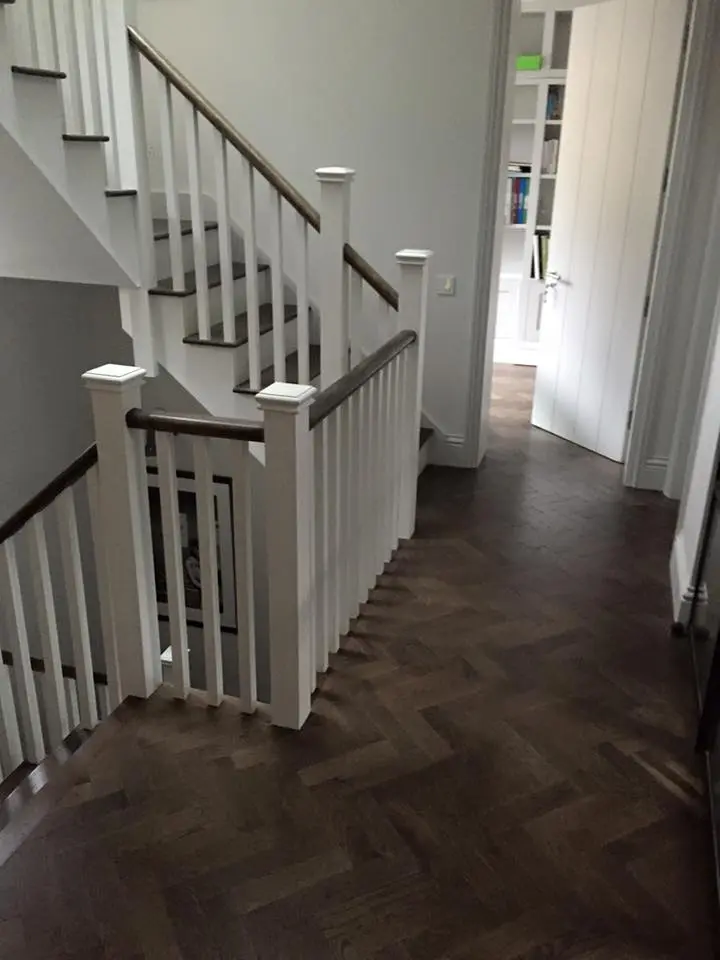
Old stairs.
New timber.
An old staircase doesn’t always need to be replaced. Cladding your staircase with new timber makes it look like new, for a fraction of the cost of replacing it.
Same stairs.
New look.
Staircase cladding means fitting new hardwood treads and risers over the top of your existing staircase. The structure of the stairs stays exactly where it is, so there is no need to rip out the old staircase or make changes to the stairwell.
If you’re having a new floor fitted in the hallway or on the landing, cladding the stairs in the same timber and finish ties the whole space together.
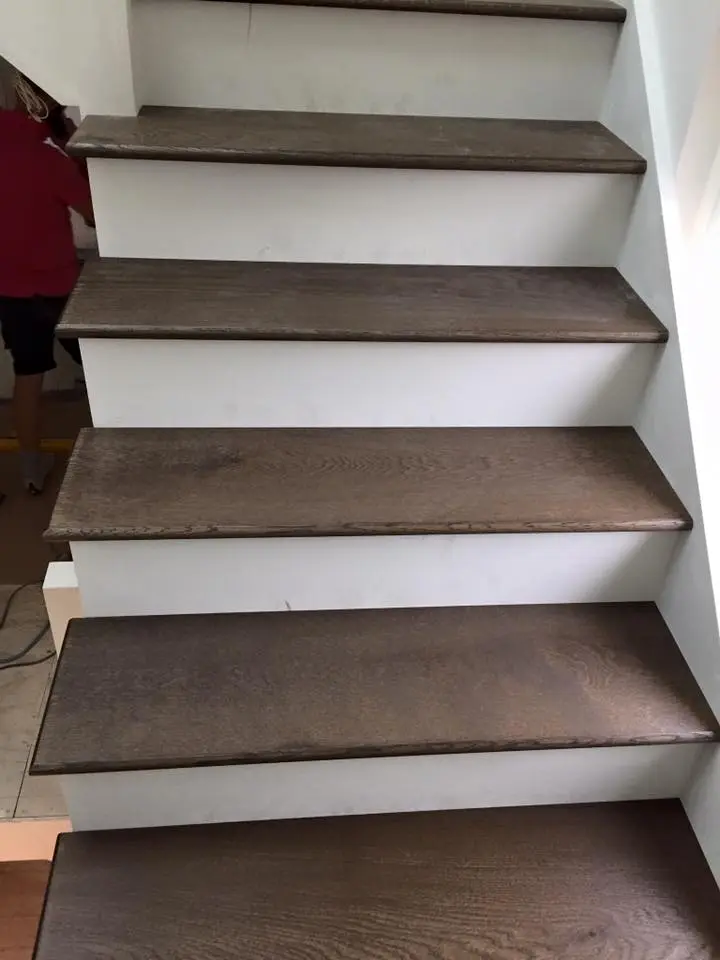
Step by step.
Every staircase is a little different, but most cladding jobs follow the same steps.
Checking the staircase
Before anything else, we check that the existing staircase is sound. The cladding is fixed to the old treads, so if a tread creaks or moves now, it will still creak or move once it has been clad. Any loose treads are screwed down or packed out first.
Preparing the stairs
Carpet, gripper rods and staples are removed, along with any old paint or varnish that would stop the adhesive from bonding. In most cases the existing nosings (the rounded front edges of the treads) are cut back flush with the risers, so that the new treads can sit flat on top.
Measuring each step
No two steps on a staircase are ever quite the same, especially in older houses where the walls are rarely square. Each tread and riser is measured on its own, so that it fits tightly between the wall and the string (the board the steps are set into at the side).
Fitting the treads and risers
The risers go on first, followed by the treads, which are bonded down with a flexible adhesive. Gluing the treads down across their whole surface is also what stops a clad staircase from creaking.
Finishing
Treads and risers supplied unfinished are sanded and sealed on site with a Hardwax oil or a lacquer, just like a floor. Lacquer is a popular choice on stairs because of the amount of foot traffic they get.
Worth thinking about.
A few things are worth thinking about before your staircase is clad. We’ll go through all of them with you on a site visit.
Matching your floor
If the hallway or landing has a wood floor, or is about to, it usually makes sense to clad the stairs in the same timber and finish so that the two flow into each other. Oak is the most popular choice, and an oak staircase sits well against almost any floor.
Painted risers
Not every riser needs to be wood. Oak treads with white painted risers is a popular look, and it can really brighten up a dark hallway.
Nosings
The front edge of each tread can be rounded or square. Rounded nosings are softer underfoot and tend to suit older houses, whilst square edges give a more modern look.
Spindles and the balustrade
Where a tread meets the spindles, the new tread either has to be cut around each spindle, or the spindles have to come out and go back in once the treads are down. Which way we go depends on how the balustrade is fixed. If you’re planning on replacing the balustrade anyway, it’s worth doing both jobs at the same time.
Step heights
Because each new tread sits on top of the old one, every step goes up by the thickness of the tread. The steps in the middle all go up by the same amount, so they stay even with each other, but the bottom and top steps can end up a different height to the rest. Building regulations require every step in a flight to be the same height, so this needs planning for. In most cases the difference is taken up by the thickness of the new floor at the top or bottom of the stairs, which is another good reason to plan the stairs and the floor together.
Grip
A freshly lacquered staircase can be slippery, especially in socks. If that’s a worry, there are anti-slip lacquers made especially for stairs, and they’re well worth considering in a house with young children or older relatives.
What it costs.
These are the rates our instant quote works from today. They're for our work, labour only: the timber isn't included.
- Cladding: £65 per stair
- Sanding and refinishing a timber staircase: £35 per stair
Most straight staircases in a house have 12 to 14 steps, so count yours before you get a quote. If yours has winders or a landing, mention them when you book a site visit.
Our instant quote works out an estimate from your answers in under two minutes. It's valid for 30 days, and we'll confirm the final price after a site visit.
Already have timber stairs?
If your staircase is already solid hardwood, it may not need cladding at all. Like a wood floor, it can usually be sanded back and refinished. Have a look at our restoration service.
Questions, answered.
Quick answers to common questions about finishes and the areas we cover.
All frequently asked questionsWhich is better, oil or lacquer?
It depends on how much traffic the floor will get and the look and feel you're after.
An oil finish leaves the wood looking and feeling more natural, but wears through quicker and needs a little more maintenance. A lacquer finish is more durable, but won't look as natural. With the right primer under the lacquer, you can get a slightly more natural look.
Which finish shows more dirt?
Gloss finishes tend to show dust more than matt finishes. A matt finish hides dust, scuff marks and wear in high traffic areas better than gloss.
Which areas do you cover?
Mainly the Chilterns, across parts of Buckinghamshire, Hertfordshire, Oxfordshire and Bedfordshire. We also work further afield, depending on the size of the job.
Outside those areas we typically don't take on jobs smaller than 30 to 40 square metres.
Team up with Spartan Flooring
We take tremendous pride in the quality of work we deliver, and we're always looking to build relationships with domestic and commercial clients.
Prefer to talk? Call 07790 884 985